Search This Blog

Tuesday, 29 January 2013

KRISHNA AND HIS KINGDOM

That is the way of the spiritual and godly life, after attaining which a man is not bewildered. Being so situated, even at the hour of death, one can enter into the kingdom of God.

eṣā brāhmī sthitiḥ pārtha
naināṁ prāpya vimuhyati
sthitvāsyām anta-kāle 'pi
brahma-nirvāṇam ṛcchati


One can attain Kṛṣṇa consciousness or divine life at once, within a second—or one may not attain such a state of life even after millions of births. It is only a matter of understanding and accepting the fact. Khaṭvāṅga Mahārāja attained this state of life just a few minutes before his death, by surrendering unto Kṛṣṇa. Nirvāṇa means ending the process of materialistic life. According to Buddhist philosophy, there is only void after the completion of this material life, but Bhagavad-gītā teaches differently. Actual life begins after the completion of this material life. For the gross materialist it is sufficient to know that one has to end this materialistic way of life, but for persons who are spiritually advanced, there is another life after this materialistic life. Before ending this life, if one fortunately becomes Kṛṣṇa conscious, he at once attains the stage of Brahma-nirvāṇa. There is no difference between the kingdom of God and the devotional service of the Lord. Since both of them are on the absolute plane, to be engaged in the transcendental loving service of the Lord is to have attained the spiritual kingdom. In the material world there are activities of sense gratification, whereas in the spiritual world there are activities of Kṛṣṇa consciousness. Attainment of Kṛṣṇa consciousness even during this life is immediate attainment of Brahman, and one who is situated in Kṛṣṇa consciousness has certainly already entered into the kingdom of God. Brahman is just the opposite of matter. Therefore brāhmī sthitiḥ means "not on the
platform of material activities." Devotional service of the Lord is accepted in the Bhagavad-gītā as the liberated stage. Therefore, brāhmī-sthitiḥ is liberation from material bondage. Śrīla Bhaktivinode Ṭhākur has summarized this Second Chapter of the Bhagavad-gītā as being the contents for the whole text. In the Bhagavad-gītā, the subject matters are karma-yoga, jñāna-yoga, and bhakti-yoga. In the Second Chapter karma-yoga and jñāna-yoga have been clearly discussed, and a glimpse of bhakti-yoga has also been given, as the contents for the complete text


.
just  visit  this  website hare krishna http://www.folknet.in/

Monday, 28 January 2013

SHRI KRISHNA GITA 2.71

A person who has given up all desires for sense gratification, who lives free from desires, who has given up all sense of proprietorship and is devoid of false ego—he alone can attain real peace

vihāya kāmān yaḥ sarvān
pumāṁś carati niḥspṛhaḥ
nirmamo nirahaṅkāraḥ
sa śāntim adhigacchati


To become desireless means not to desire anything for sense gratification. In other words, desire for becoming Kṛṣṇa conscious is actually desirelessness. To understand one's actual position as the eternal servitor of Kṛṣṇa, without falsely claiming this material body to be oneself and without falsely claiming proprietorship over anything in the world, is the perfect stage of Kṛṣṇa consciousness. One who is situated in this perfect stage knows that because Kṛṣṇa is the proprietor of everything, therefore everything must be used for the satisfaction of Kṛṣṇa. Arjuna did not want to fight for his own sense satisfaction, but when he became fully Kṛṣṇa conscious he fought because Kṛṣṇa wanted him to fight. For himself there was no desire to fight, but for Kṛṣṇa thesame Arjuna fought to his best ability. Desire for the satisfaction of Kṛṣṇa is reallydesirelessness; it is not an artificial attempt to abolish desires. The living entity cannot be desireless or senseless, but he does have to change the quality of the desires. Amaterially desireless person certainly knows that everything belongs to Kṛṣṇa (īśāvāsyam idaṁ sarvam), and therefore he does not falsely claim proprietorship over anything. This transcendental knowledge is based on self-realization—namely, knowing perfectly well that every living entity is the eternal part and parcel of Kṛṣṇa in spiritual identity. and therefore the eternal position of the living entity is never on thelevel of Kṛṣṇa or greater than Him. This understanding of Kṛṣṇa consciousness is the basic principle of real peace

CHANT  HARE  KRSNA   AND   BE  HAPPY .

Sunday, 27 January 2013

PEACE IN KRISHNA CONCIOUSNESS


One who is not in transcendental consciousness can have neither a controlled mind nor steady intelligence, without which there is no possibility of peace. And how can there be any happiness without peace?

nāsti buddhir ayuktasya
na cāyuktasya bhāvanā
na cābhāvayataḥ śāntir
aśāntasya kutaḥ sukham(BG 2.66)


Unless one is in Kṛṣṇa consciousness, there is no possibility of peace. So it is confirmed in the Fifth Chapter (5.29) that when one understands that Kṛṣṇa is the only enjoyer of all the good results of sacrifice and penance, and that He is the proprietor of all universal manifestations, that He is the real friend of all living entities, then only can one have real peace. Therefore,  if  one  is  not  in  Kṛṣṇa conciousness , there cannot be a final goal for the mind. Disturbance is due to want of an ultimate goal, and when one is certain that Kṛṣṇa is the enjoyer,  proprietor and friend of everyone and everything, then one can, with a steady mind, bring about peace. Therefore, one who is engaged without a relationship with Kṛṣṇa is certainly always in distress and is without peace, however much one may make a show of peace and spiritual advancement in life. Kṛṣṇa consciousness is a self-manifested peaceful condition which can be achieved only in relationship with Kṛṣṇa.

Saturday, 26 January 2013

SHRI KRISHNA

Krishna is Sanskrit for "the all-attractive Person." It is a name frequently used to refer to the Supreme Being in some of the Vedic writings of India, especially those dealing with the science of devotion to God like the Srimad Bhagavatam and the BhagavadGita. They explain that Krishna is the original supreme person, the Absolute Truth, the ultimate source of all energies and of all other incarnations of God.

Krishna's appearance and activities on earth are the main subject of the Srimad-Bhagavatam, an extensive chronicle of many incarnations of God on Earth. The Bhagavatam's first nine cantos describe Krishna as the almighty origin of all things, how He creates and maintains the universe, and some of His many avatars (incarnations), while the Tenth Canto gives us a picture of His private life — as a beautiful, playful young cowherd boy in the rural setting of  Vrindavan(in modern-day Uttar Pradesh, India).

In the Bhagavad-gita, which Krishna spoke to His friend Arjuna on a battlefield, He explains theistic philosophy in a nutshell, i.e., that the self always exists and can never die, that we're meant to live in harmony with the supreme will, and that He (God) can most easily be known through the process of bhakti-yoga, devotional service to the Supreme Person.

The Vedas say Krishna is the original person, but that He always appears young and attractive. He knows everything, He contains all of reality, and all other living beings are His inseparable parts. He is the all-powerful, supreme controller of all energies. He is known by different names in different cultures (such as God, Allah, and Jehovah, for example)

   Sometimes Krishna sends His representatives—as saints, prophets, or His sons—to teach humankind about Him, and sometimes He comes Himself, as He did approximately 3000 B.C. He spoke the spiritual and philosophical teachings known as the Bhagavad-gita, which explains the essence of our spiritual identity and our relationship with God.
 

Friday, 25 January 2013

KRSNA( GOD ) AND HIS FORM

WHAT IS GOD LIKE ?


As with anyone in our experience, God is unique and complex. He's the transcendental Supreme Person, so there's infinitely more to know about Him than anyone else. The Vedas, suppy detailed information about  krishna. Everything about God is fully transcendental, or spiritual. Because God is absolute, there is no difference between Him and His name, form, activities, qualities, and so on. Contact with any of these gives the same spiritual benefit, namely purification of our consciousness.

KRISHNA'S  FORM

The Vedas tell us that spirit is composed of eternity, knowledge (or consciousness), and happiness. Both God and we souls possess spiritual forms, which are free of the limitations of material form. For example, each part of a spiritual body can perform the function of any other part.

Krishna’s body never changes; He is an eternal youth. 

Unlike us ordinary souls, who may possess a material body, Krishna and His body are always identical.


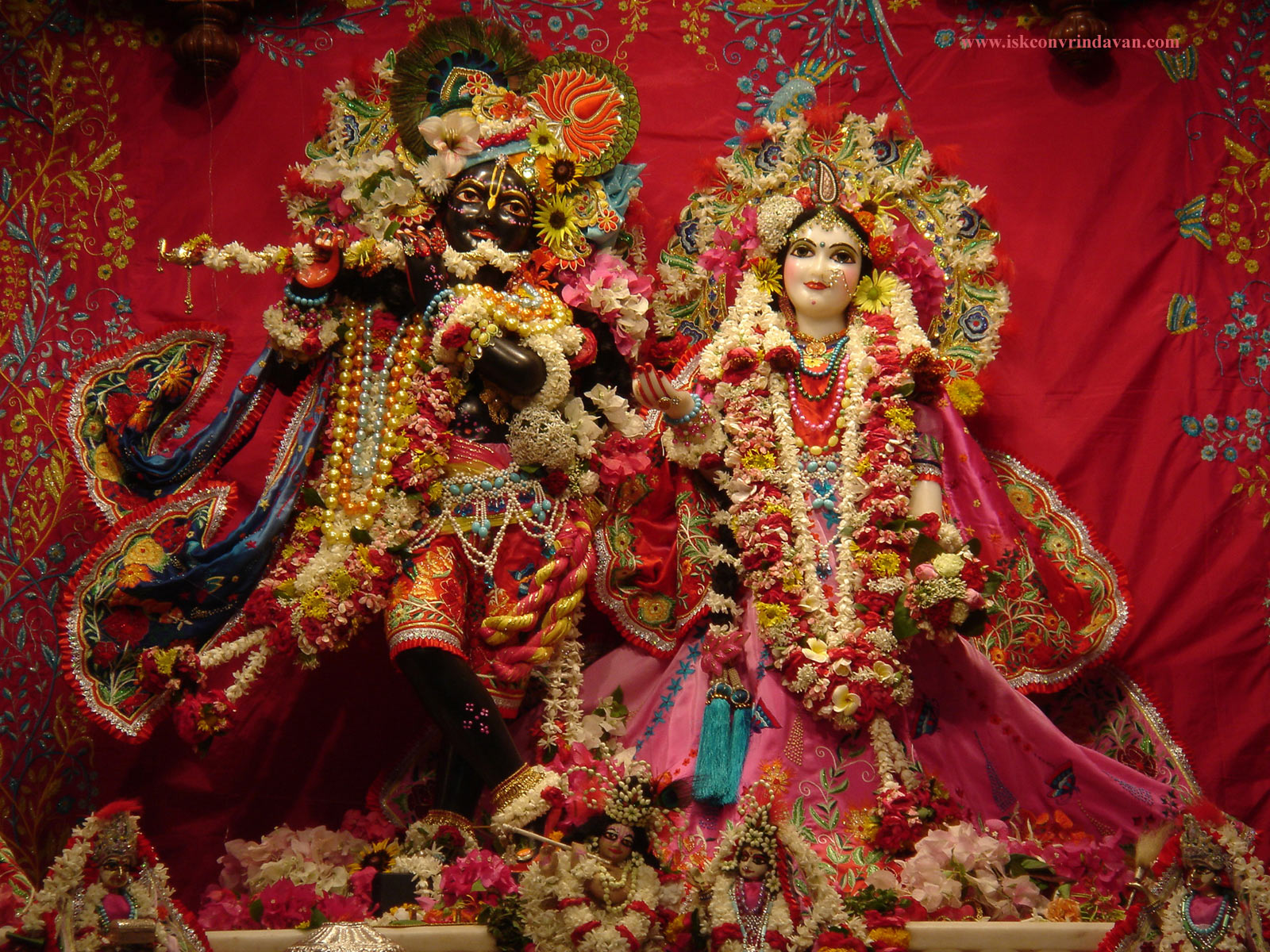
The Vedas describe Krishna in this way: He is a beautiful youth with a glowing complexion the color of rain clouds. He plays a flute, attracting the hearts of all. His cheeks are brilliant, His smiling enchanting. He wears a peacock feather in His curly black hair and a flower garland around His neck. His beautiful garments are the color of lightning. His toenails resemble the light of the moon.

Not only do the Vedas tell us what Krishna looks like, but pure souls have received His audience and written of their encounters. And fifty centuries ago, Krishna revealed His transcendental form to residents of India when He lived there for 125 years, sometimes showing and sometimes hiding His divinity.

"Ornaments caress Krishna's body, but His transcendental body is so beautiful that it beautifies the ornaments He wears. Therefore Krishna’s body is said to be the ornament of ornaments. Enhancing the wonderful beauty of Krishna is His three-curved style of standing." –Chaitanya Charitamrita, 


HARE KRSNA  HARE KRSNA , KRSNA KRSNA HARE HARE
HARE  RAMA HARE RAMA , RAMA RAMA HARE HARE 


Thursday, 24 January 2013

HOW ONE CAN ATTAIN MERCY OF THE KRSNA

One who can control his senses by practicing the regulated principles of freedom can obtain the complete mercy of the Lord and thus become free from all attachment and aversion.

rāga-dveṣa-vimuktais tu
viṣayān indriyaiś caran
ātma-vaśyair vidheyātmā
prasādam adhigacchati


It is already explained that one may externally control the senses by some artificial process, but unless the senses are engaged in the transcendental service of the Lord,there is every chance of a fall. Although the person in full Kṛṣṇa consciousness may apparently be on the sensual plane, because of his being Kṛṣṇa conscious, he has no
attachment to sensual activities. The Kṛṣṇa conscious person is

concerned only with the satisfaction of Kṛṣṇa, and nothing else. Therefore he is transcendental to all attachment. If Kṛṣṇa wants, the devotee can do anything which is ordinarily undesirable; and if Kṛṣṇa does not want, he shall not do that which he would have ordinarily done for his own satisfaction. Therefore to act or not to act is within his control because he acts only under the direction of Kṛṣṇa. This consciousness is the causeless mercy of the Lord, which the devotee can achieve in spite of his being  attached to the sensual platform. So, one  who follows the  regulated  principles and has a contol  over  the  senses .He can attain the  complete mercy of the lord krsna.

Wednesday, 23 January 2013

ANGER SHOULD BE AVOIDED IN KRSNA CONCIOUSNESS


From anger, delusion arises, and from delusion bewilderment of memory. When memory is bewildered, intelligence is lost, and when intelligence is lost, one falls down again into the material pool

krodhād bhavati sammohaḥ
sammohāt smṛti-vibhramaḥ
smṛti-bhraṁśād buddhi-nāśo
buddhi-nāśāt praṇaśyati


By development of Kṛṣṇa consciousness one can know that everything has its use in the service of the Lord. Those who are without knowledge of Kṛṣṇa consciousness artificially try to avoid material objects, and as a result, although they desire liberation from material bondage, they do not attain to the perfect stage of renunciation. On the
other  hand, a person in Kṛṣṇa consciousness  knows  ho to  use everything in the service of the Lord; therefore he does not become a victim of material consciousness. For example, for an impersonalist, the Lord, or the Absolute, being impersonal, cannot eat. Whereas an impersonalist tries to avoid good eatables, a devotee knows that Kṛṣṇa is the supreme enjoyer and that He eats all that is offered to Him in devotion. So, after offering good eatables to the Lord, the devotee takes the remnants, called prasādam. Thus everything becomes spiritualized and there is no danger of a downfall. The devotee takes prasādam in Kṛṣṇa consciousness, whereas the nondevotee rejects it as
material. The impersonalist, therefore, cannot enjoy life due to his artificial renunciation; and for this reason, a slight agitation of the mind pulls him down again into the pool of material existence. It is said that such a soul, even though rising up to the point of liberation, falls down again due to his not having support in devotional service.

Tuesday, 22 January 2013

RADHA MADAN MOHAN ISKCON GERMANY


HOW TO RISING UP FROM POOL OF MATERIAL EXISTENCE


              From anger, delusion arises, and from delusion bewilderment of memory. When memory is bewildered, intelligence is lost, and when intelligence is lost, one falls down again into the material pool.


krodhād bhavati sammohaḥ
sammohāt smṛti-vibhramaḥ
smṛti-bhraṁśād buddhi-nāśo
buddhi-nāśāt praṇaśyati


By development of Kṛṣṇa consciousness one can know that everything has its use in the service of the Lord. Those who are without knowledge of Kṛṣṇa consciousness artificially try to avoid material objects, and as a result,   although   they    desire    liberation from material bondage, they do not attain to the perfect stage of renunciation. On the other hand, a person in Kṛṣṇa consciousness knows how to use everything in the service of the Lord; therefore he does not become a victim of material consciousness. For example, for an impersonalist, the Lord, or the Absolute, being impersonal, cannot eat. Whereas an impersonalist tries to avoid good eatables, a devotee knows that Kṛṣṇa is the supreme enjoyer and that He eats all that is offered to Him in devotion. So, after offering good eatables to the Lord, the devotee takes the remnants, called prasādam. Thus everything becomes spiritualized and there is no danger of a downfall. The devotee takes prasādam in Kṛṣṇa consciousness, whereas the nondevotee rejects it as material. The impersonalist, therefore, cannot enjoy life due to his artificial renunciation; and for this reason, a slight agitation of the mind pulls him down again into the pool of material existence. It is said that such a soul, even though rising up to the point of liberation, falls down again due to his not having support in devotional service.

Monday, 21 January 2013

ANGER _ORIGINATES

while  contemplating  the  objects of the  senses , a  person  develops 
attachments  for  them , and  from  such  attachment  lust  develops , and  from  lust  anger  arises

dhyāyato viṣayān puṁsaḥ
saṅgas teṣūpajāyate
saṅgāt sañjāyate kāmaḥ
kāmāt krodho 'bhijāyate


A person  who is not Kṛṣṇa conscious is subjected to material desires while contemplating the objects of senses. The senses require real engagements, and if they are not engaged in the transcendental loving service of the Lord, they will certainly seek engagement in the service of materialism. In the material world everyone, including Lord Śiva and Lord Brahmā—to say nothing of other demigods in the heavenly planets—is subjected to the influence of sense objects, and the only method to get out of this puzzle of material existence is to become Kṛṣṇa conscious. Lord Śiva was deep in meditation, but when Pārvatī agitated him for sense pleasure, he agreed to the proposal, and as a result Kārtikeya was born. When Haridāsa Ṭhākur was a young devotee of the Lord, he was similarly allured by the incarnation of Māyā Devī, but Haridāsa easily passed the test because of his unalloyed devotion to Lord Kṛṣṇa. As illustrated in the above-mentioned verse of Śrī Yāmunācārya, a sincere devotee of the Lord shuns all material sense enjoyment due to his higher taste for spiritual enjoyment in the association of the Lord. That is the secret of success. One who is not, therefore, in Kṛṣṇa consciousness, however powerful he may be in controlling the senses by artificial repression, is sure . ultimately to fail, for the slightest thought of sense pleasure will agitate him to gratify his desires

Sunday, 20 January 2013

ALL THE SENSES USED in KRSNA CONCIOUSNESS

KRSNA  SAID : One  who  restrains  his  senses  and  fixes  his  conciousness  upon  me  is  known  as  a man of  steady  intelligence .

 That the highest conception of yoga perfection is Kṛṣṇa consciousness is clearly
explained in this verse. And, unless one is Kṛṣṇa conscious, it is not at all possible to
control the senses. As cited above, the great sage Durvāsā Muni picked a quarrel with
Mahārāja Ambarīṣa, and Durvāsā Muni unnecessarily became angry out of pride and
therefore could not check his senses. On the other hand, the King, although not as
powerful a yogī as the sage, but a devotee of the Lord, silently tolerated all the sage's
injustices and thereby emerged victorious. The King was able to control his senses
because of the following qualifications, as mentioned in the Śrīmad-Bhāgavatam:


sa vai manaḥ kṛṣṇa-padāravindayor
vacāṁsi vaikuṇṭha-guṇānavarṇane
karau harer mandira-mārjanādiṣu
śrutiṁ cakārācyuta-sat-kathodaye
mukunda-liṅgālaya-darśane dṛśau
tad-bhṛtya-gātra-sparśe'ṅga-saṅgamam
ghrāṇaṁ ca tat-pāda-saroja-saurabhe
śrīmat-tulasyā rasanāṁ tad-arpite
pādau hareḥ kṣetra-padānusarpaṇe
śiro hṛṣīkeśa-padābhivandane
kāmaṁ ca dāsye na tu kāma-kāmyayā
yathottamaśloka-janāśrayā ratiḥ


"King Ambarīṣa fixed his mind on the lotus feet of Lord Kṛṣṇa, engaged his words in describing the abode of the Lord, his hands in cleansing the temple of the Lord, his ears in hearing the pastimes of the Lord, his eyes in seeing the form of the Lord, his body in touching the body of the devotee, his nostrils in smelling the flavor of the flowers offered to the lotus feet of the Lord, his tongue in tasting the tulasī leaves offered to Him, his legs in traveling to the holy place where His temple is situated, his head in offering obeisances unto the Lord, and his desires in fulfilling the desires of the Lord ...and all these qualifications made him fit to become a mat-paraḥ devotee of the Lord." (Bhāg. 9.4.18-20)
 

The word mat-paraḥ is most significant in this connection. How one can become amat-paraḥ is described in the life of Mahārāja Ambarīṣa. Śrīla Baladeva Vidyābhūṣaṇa,a great scholar and ācārya in the line of the mat-paraḥ, remarks: "mad-bhakti-prabhāvena sarvendriya-vijaya-pūrvikā svātma dṛṣṭiḥ sulabheti bhāvaḥ." "The senses can be completelycontrolled only by the strength of devotional service to
Kṛṣṇa." Also the example of fire is sometimes given: "As the small flames within burn everything within the room, similarly Lord Viṣṇu, situated in the heart of the yogī, burns up all kinds of impurities." The Yoga-sūtra also prescribes meditation on Viṣṇu, and not meditation on the void. The so-called yogīs who meditate on something which is not the Viṣṇu form simply waste their time in a vain search after some
phantasmagoria. We have to be Kṛṣṇa conscious-devoted to the Personality of Godhead. This is the aim of the real yoga.

Saturday, 19 January 2013

KRISHNA_FESTIVAL_AT_AHMEDABAD

HARE KRSNA  viewers

Last  night  I was  at the  Krishna  Festival   in   Ahmedabad .A swami  indradyumn was  present , who  was   initiated   by  shrila  Prabhupad  in  1967 in  America .He  was a  US  commando , but  as   he  came  under shrila Prabhupad's  presence . He  left  his   job  and  became  the  disciple  of  shrila Prabhupad .He  has  come  to  ahmedabad  for  the  Krishna Festival  with  his  35  disciples .There  were  many  programmes like  a play of GITA  ,Puppet show Magic  show , a  dance  shows  based  on  Bharatnatyam and Kathak . A  kirtan   was  also  performed  by  Indradyumn  swami . At  the  end , There  was  a  Prasad distribution  also . A  nice  Krishna  Conscious  time  at  the  Festival .


CHANT   HARE  KRSNA  AND  BE  HAPPY .

HARE KRSNA: BHAGVAD_GITA CHAPTER_2 VERSE_12

http://www.krishna.comHARE KRSNA: BHAGVAD_GITA CHAPTER_2 VERSE_12

BHAGVAD_GITA CHAPTER_2 VERSE_12

VERSE 12

na tv evāhaṁ jātu nāsaṁ
na tvaṁ neme janādhipāḥ
na caiva na bhaviṣyāmaḥ
sarve vayam ataḥ param


SYNONYMS

na—never; tu—but; eva—certainly; aham—I; jātu—become; na—never;āsam—existed; na—it is not so; tvam—yourself; na—not; ime—all these;janādhipāḥ—kings; na—never; ca—also; eva—certainly; na—not like that;bhaviṣyāmaḥ—shall exist; sarve—all of us; vayam—we; ataḥ param—hereafter

TRANSLATION

Never was there a time when I did not exist, nor you, nor all these kings; nor in the
future shall any of us cease to be.


PURPORT

In the Vedas, in the Kaṭha Upaniṣad as well as in the Śvetāśvatara Upaniṣad, it is said
that the Supreme Personality of Godhead is the maintainer of innumerable living
entities, in terms of their different situations according to individual work and reaction
of work. That Supreme Personality of Godhead is also, by His plenary portions, alive in
the heart of every living entity. Only saintly persons who can see, within and without,
the same Supreme Lord, can actually attain to perfect and eternal peace.


nityo nityānāṁ cetanaś cetanānām
eko bahūnāṁ yo vidadhāti kāmān
tam ātmasthaṁ ye 'nupaśyanti dhīrās
teṣāṁ śāntiḥ śāśvatī netareṣām.
(Kaṭha 2.2.13)


The same Vedic truth given to Arjuna is given to all persons in the world who pose
themselves as very learned but factually have but a poor fund of knowledge. The Lord
says clearly that He Himself, Arjuna, and all the kings who are assembled on the
battlefield, are eternally individual beings and that the Lord is eternally the maintainer
of the individual living entities both in their conditioned as well as in their liberated
situations. The Supreme Personality of Godhead is the supreme individual person, and
Arjuna, the Lord's eternal associate, and all the kings assembled there are individual,
eternal persons. It is not that they did not exist as individuals in the past, and it is not
that they will not remain eternal persons. Their individuality existed in the past, and
their individuality will continue in the future without interruption. Therefore, there is
no cause for lamentation for anyone.
The Māyāvādī theory that after liberation the individual soul, separated by the
covering of māyā or illusion, will merge into the impersonal Brahman and lose its
individual existence is not supported herein by Lord Kṛṣṇa, the supreme authority. Nor is the theory that we only think of individuality in the conditioned state supported
herein. Kṛṣṇa clearly says herein that in the future also the individuality of the Lord
and others, as it is confirmed in the Upaniṣads, will continue eternally. This statement
of Kṛṣṇa is authoritative because Kṛṣṇa cannot be subject to illusion. If individuality is
not a fact, then Kṛṣṇa would not have stressed it so much—even for the future. The
Māyāvādī may argue that the individuality spoken of by Kṛṣṇa is not spiritual, but
material. Even accepting the argument that the individuality is material, then how can
one distinguish Kṛṣṇa's individuality? Kṛṣṇa affirms His individuality in the past and
confirms His individuality in the future also. He has confirmed His individuality in
many ways, and impersonal Brahman has been declared to be subordinate to Him.
Kṛṣṇa has maintained spiritual individuality all along; if He is accepted as an ordinary
conditioned soul in individual consciousness, then His Bhagavad-gītā has no value as
authoritative scripture. A common man with all the four defects of human frailty is
unable to teach that which is worth hearing. The Gītā is above such literature. No
mundane book compares with the Bhagavad-gītā. When one accepts Kṛṣṇa as an
ordinary man, the Gītā loses all importance. The Māyāvādī argues that the plurality
mentioned in this verse is conventional and that it refers to the body. But previous to
this verse such a bodily conception is already condemned. After condemning the bodily
conception of the living entities, how was it possible for Kṛṣṇa to place a conventional
proposition on the body again? Therefore, individuality is maintained on spiritual
grounds and is thus confirmed by great ācāryas like Śrī Rāmānuja and others. It is
clearly mentioned in many places in the Gītā that this spiritual individuality is
understood by those who are devotees of the Lord. Those who are envious of Kṛṣṇa as
the Supreme Personality of Godhead have no bona fide access to the great literature.
The nondevotee's approach to the teachings of the Gīta is something like bees licking
on a bottle of honey. One cannot have a taste of honey unless one opens the bottle.
Similarly, the mysticism of the Bhagavad-gītā can be understood only by devotees, and
no one else can taste it, as it is stated in the Fourth Chapter of the book. Nor can the
Gītā be touched by persons who envy the very existence of the Lord. Therefore, the
Māyāvādī explanation of the Gītā is a most misleading presentation of the whole truth.
Lord Caitanya has forbidden us to read commentations made by the Māyāvādīs and
warns that one who takes to such an understanding of the Māyāvādī philosophy loses
all power to understand the real mystery of the Gītā. If individuality refers to the
empirical universe, then there is no need of teaching by the Lord. The plurality of the
individual soul and of the Lord is an eternal fact, and it is confirmed by the Vedas as
above mentioned.


Friday, 18 January 2013

ARJUNA_IS_FOOL_CHAPTER_2 VERSE_11

VERSE 11

śrī-bhagavān uvāca
aśocyān anvaśocas tvaṁ
prajñā-vādāṁś ca bhāṣase
gatāsūn agatāsūṁś ca
nānuśocanti paṇḍitāḥ


SYNONYMS


śrī bhagavān uvāca—the Supreme Personality of Godhead said; aśocyān—that which is
not worthy of lamentation; anvaśocaḥ—you are lamenting; tvam—you;
prajñā-vādāḥ—learned talks; ca—also; bhāṣase—speaking; gata—lost; asūn—life;
agata—not past; asūn—life; ca—also; na—never; anuśocanti—lament; paṇḍitāḥ—the
learned


TRANSLATION

The Blessed Lord said: While speaking learned words, you are mourning for what is
not worthy of grief. Those who are wise lament neither for the living nor the dead.


PURPORT

The Lord at once took the position of the teacher and chastised the student, calling
him, indirectly, a fool. The Lord said, you are talking like a learned man, but you do not
know that one who is learned—one who knows what is body and what is soul—does
not lament for any stage of the body, neither in the living nor in the dead condition. As
it will be explained in later chapters, it will be clear that knowledge means to know
matter and spirit and the controller of both. Arjuna argued that religious principles
should be given more importance than politics or sociology, but he did not know that
knowledge of matter, soul and the Supreme is even more important than religious
formularies. And, because he was lacking in that knowledge, he should not have posed
himself as a very learned man. As he did not happen to be a very learned man, he
was
consequently lamenting for something which was unworthy of lamentation. The body is
born and is destined to be vanquished today or tomorrow; therefore the body is not as
important as the soul. One who knows this is actually learned, and for him there is no
cause for lamentation, regardless of the condition of the material body.


Thursday, 17 January 2013

BHAGAVAD GITA CHAPTER_2 VERSE_10

HARE KRSNA   TO  ALL ,. 
VERSE 10

tam uvāca hṛṣīkeśaḥ
prahasann iva bhārata
senayor ubhayor madhye
viṣīdantam idaṁ vacaḥ


SYNONYMS

tam—unto him; uvāca—said; hṛṣīkeśaḥ—the master of the senses, Kṛṣṇa;
prahasan—smiling; iva—like that; bhārata—O Dhṛtarāṣṭra, descendant of Bharata;
senayoḥ—of the armies; ubhayoḥ—of both parties; madhye—between;
viṣīdantam—unto the lamenting one; idam—the following; vacaḥ—words.


TRANSLATION

O descendant of Bharata, at that time Kṛṣṇa, smiling, in the midst of both the armies,
spoke the following words to the grief-stricken Arjuna.


PURPORT

The talk was going on between intimate friends, namely the Hṛṣīkeśa and the
Guḍākeśa. As friends, both of them were on the same level, but one of them voluntarily
became a student of the other. Kṛṣṇa was smiling because a friend had chosen to
become a disciple. As Lord of all, He is always in the superior position as the master of
everyone, and yet the Lord accepts one who wishes to be a friend, a son, a lover or a
devotee, or who wants Him in such a role. But when He was accepted as the master, He
at once assumed the role and talked with the disciple like the master—with gravity, as
it is required. It appears that the talk between the master and the disciple was openly
exchanged in the presence of both armies so that all were benefitted. So the talks of
Bhagavad-gītā are not for any particular person, society, or community, but they are for
all, and friends or enemies are equally entitled to hear them.